
That Spot Has Been There for Months. Here’s What to Do.
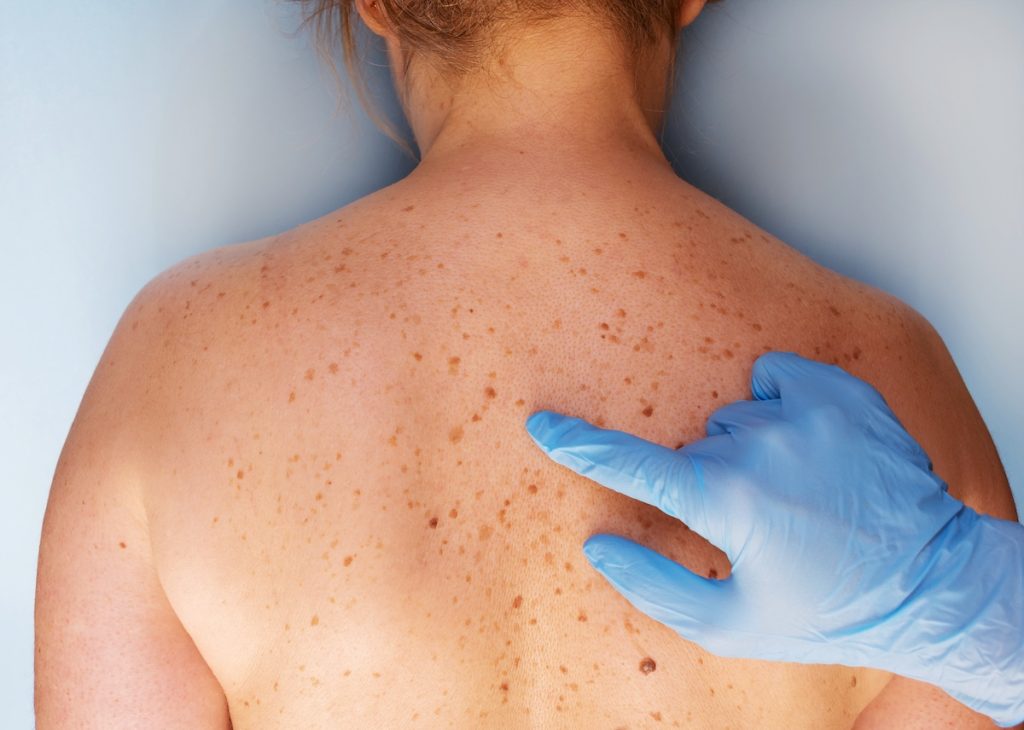
Most spots on the skin have a perfectly ordinary explanation. But when something lingers, changes, or simply doesn’t look quite right, it’s worth paying attention. Skin cancer is among the most common cancers in the United States, and it’s also among the most treatable when caught early. Knowing the skin cancer warning signs and when to act on them can make a meaningful difference.
What Are the Warning Signs of Skin Cancer?
The ABCDE framework is the most widely used tool for recognizing the early warning signs of melanoma, the most serious form of skin cancer. At Dermatology Associates of Plymouth Meeting, providers use these criteria during comprehensive skin exams to identify spots that warrant a closer look.
A is for Asymmetry.
If you drew a line through the center of a spot and the two halves don’t match, that’s worth noting. Asymmetry alone doesn’t confirm skin cancer, but it’s a signal worth bringing to your dermatologist.
B is for Border.
Healthy moles have smooth, well-defined edges. Melanomas often have irregular, ragged, or blurred borders, as though the pigment is bleeding into the surrounding skin.
C is for Color.
A normal mole is one consistent shade of brown or tan. Multiple colors within a single spot, including shades of black, red, white, or blue, can indicate abnormal cell development.
D is for Diameter.
Melanomas are often larger than 6 millimeters, roughly the size of a pencil eraser, though some are detected at smaller sizes. Catching something early, before it grows, is always the goal.
E is for Evolving.
This is often the most telling warning sign of skin cancer. A spot that changes in size, shape, color, or texture over weeks or months should be taken seriously. When something evolves, it’s time to get it checked.
What Do Basal Cell and Squamous Cell Carcinoma Look Like?
Melanoma gets the most attention, but basal cell carcinoma (BCC) and squamous cell carcinoma (SCC) are far more common. They can develop any time of year from cumulative sun exposure, not just in summer.
Basal Cell Carcinoma typically grows slowly and rarely spreads, but left untreated, it can cause significant damage to surrounding tissue. It often appears as a pearly or waxy bump, a flat pinkish lesion resembling a scar, or a growth that bleeds, crusts, and partially heals before reopening.
Squamous Cell Carcinoma carries a slightly higher risk of spreading, particularly when it goes undetected. It often presents as a firm red nodule, a rough scaly patch that bleeds easily, or an open sore that cycles between healing and returning.
Both are highly treatable when caught early. The problem is that patients frequently mistake them for something minor, a pimple that keeps coming back, a dry patch that won’t clear up, a spot that just doesn’t heal. That habit of explaining away a persistent spot is one reason these cancers are sometimes found later than they should be.
Who Is at Higher Risk for Skin Cancer?
Anyone can develop skin cancer, but certain factors increase the likelihood:
- A history of significant sun exposure or frequent sunburns, especially in childhood
- Use of tanning beds
- Fair skin, light eyes, or red or blond hair
- A personal or family history of skin cancer
- A large number of moles or a history of atypical moles
- Significant time spent outdoors
- A weakened immune system or immunosuppressive medications
It’s also worth noting that skin cancer affects people of all skin tones. In darker skin tones, it’s sometimes diagnosed at a more advanced stage because early warning signs can be harder to recognize.
How to Do a Monthly Skin Self-Exam
A monthly self-exam is one of the most practical habits you can build between dermatology visits. Use good lighting and a full-length mirror, adding a handheld mirror for hard-to-see areas like the scalp, behind the ears, and the backs of the legs. Work systematically from head to toe, including between the toes and under the nails. If something looks different from one month to the next, photograph it and call the office rather than waiting for your next scheduled appointment.
When Should You See a Dermatologist for a Skin Spot?
You don’t need a dramatic-looking lesion to make an appointment. Come in for any of the following:
- A spot or sore that hasn’t healed after several weeks
- A mole or growth that has changed in size, shape, or color
- Anything that itches, bleeds, or crusts without explanation
- A spot that has simply been bothering you, even if you can’t say exactly why
Dr. Wolfe, who has spent decades specializing in skin cancer and melanoma, and Dr. Cantor, who pursued dedicated melanoma research before joining the practice, both share the same view: early detection is the most effective tool available. If a spot has been on your radar for months, now is the right time to get an answer.
Contact Dermatology Associates of Plymouth Meeting to schedule a skin cancer screening.